How I built this
A case study of DoesAIKnowMyBusiness.com: a free tool that checks whether AI assistants recommend a local business, then writes a fix plan. Designed, built and shipped by Nick Castro in October 2026.
The problem
More customers ask ChatGPT, Gemini and other assistants “who’s the best roofer near me?” instead of scrolling Google. An assistant names only a handful of businesses. Most local business owners have no idea whether they’re on that list, or whether AI has their address, phone and hours right.
Who it’s for
- Local business owners who want a quick, free answer and a concrete to-do list, in English or Spanish.
- My web services business. The report ends with an offer to fix the issues, so the tool doubles as lead generation.
How it works
- Ranks the business. Gemini, with Google Search grounding, is asked “Who are the best [trade] in [city]?” and the answer is parsed to see whether the business is named and at what position.
- Fact-checks what AI knows. A second grounded call asks what AI knows about the business (address, phone, hours, reviews), and the answers are compared with the business’s own website.
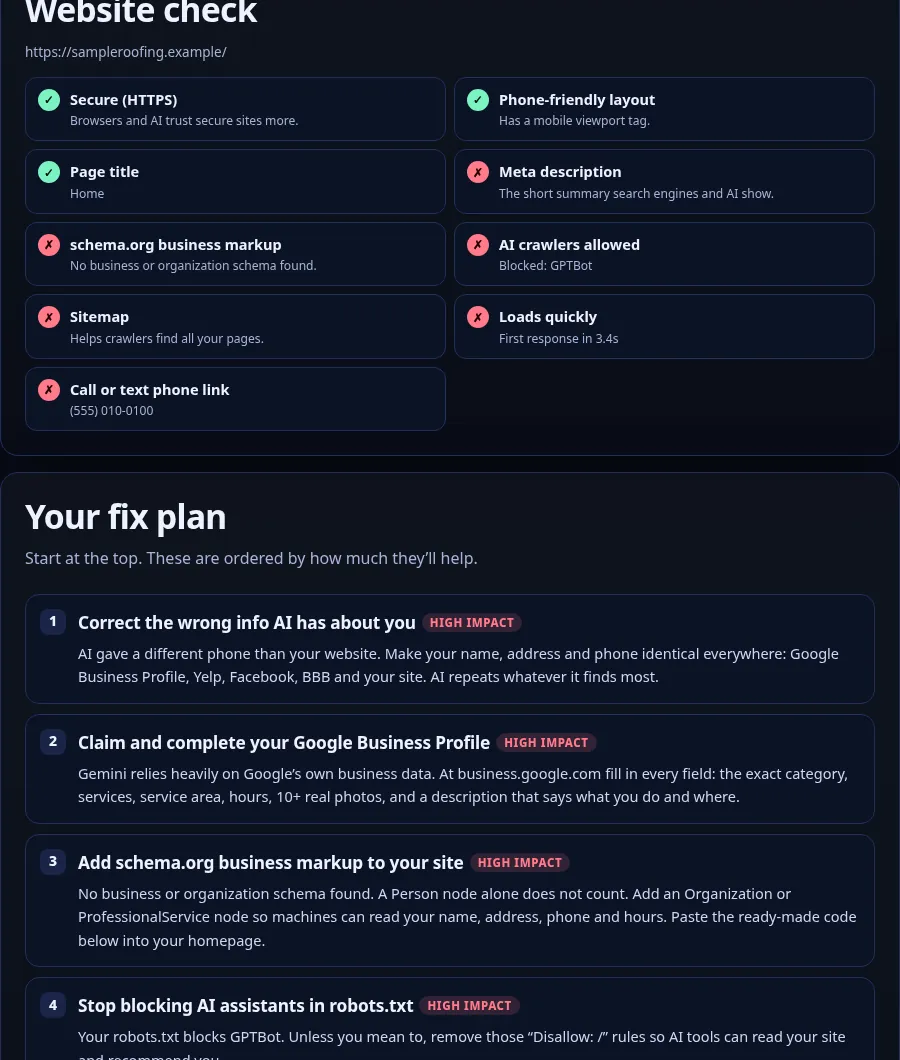
- Audits the website. HTTPS, schema.org business markup, robots.txt rules for AI crawlers, tap-to-call phone links, title and description, and how fast the page responds.
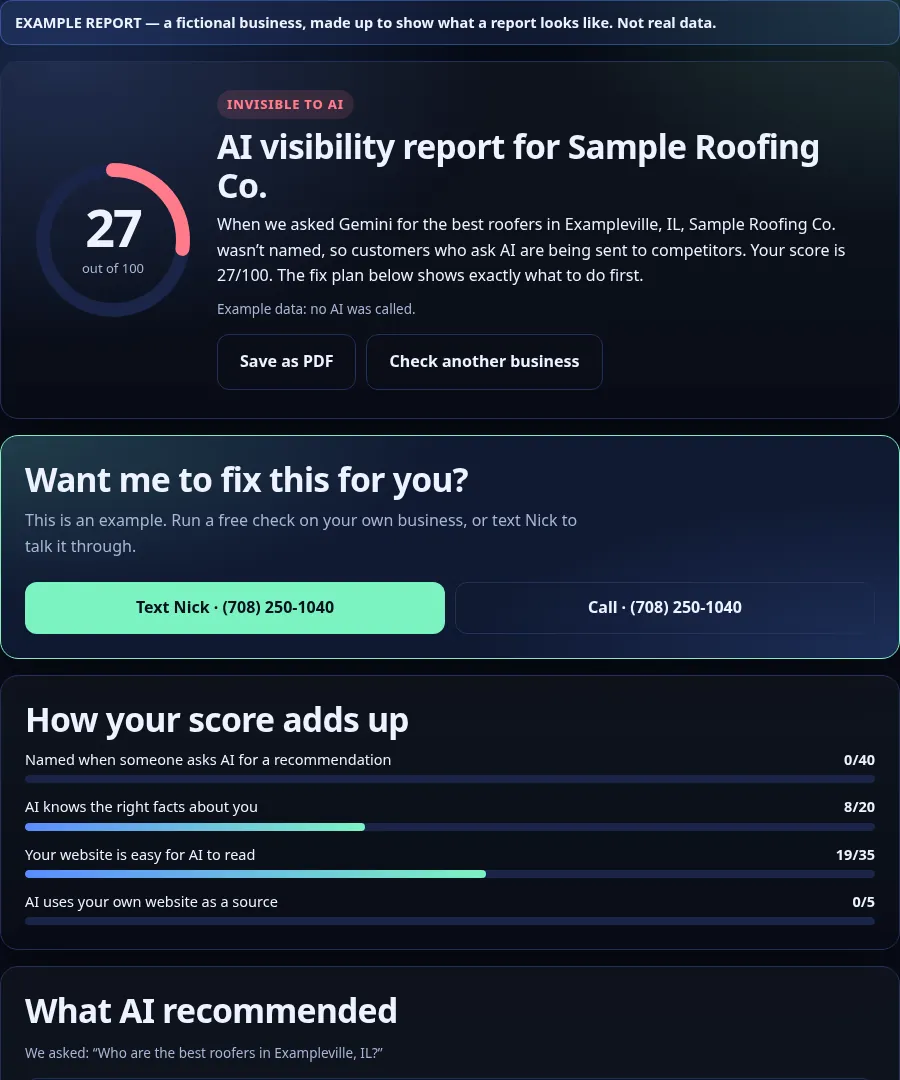
- Scores and plans. A 0–100 score with the math shown, the competitors AI named instead, and a prioritized fix plan with ready-to-paste JSON-LD.
Each step streams to the browser as it runs, so users watch the agent work instead of staring at a spinner.
Architecture
POST business name, city, type, website ↓ · steps stream back ↑
What the report looks like
Stack
- Static HTML + vanilla JS
- Vercel hosting
- Vercel Functions
- Gemini API + Google Search grounding
- Upstash Redis
- GA4
- Google Search Console
- English / Spanish
Upstash Redis handles three jobs: per-IP rate limits and the daily cap, saved leads, and share-link snapshots. No framework, no build step, and no client-side dependencies.
How I used AI to build it
I directed AI coding assistants working on a dedicated development machine. I set the goals and constraints, wrote the specs for each change, and reviewed every diff. Every change shipped through a GitHub pull request with automated tests (Node’s built-in test runner) before Vercel deployed it to production. The AI did much of the typing. Product decisions, review and the merge button stayed with me.
Key decisions and tradeoffs
- Free, with daily caps. 3 checks per person per day plus a site-wide daily cap keep API costs predictable without a paywall.
- One model, not several. Querying ChatGPT, Perplexity and others would be more complete but would cost money per check. One grounded Gemini check keeps it free, and the report says so plainly.
- No paid fix packages. The tool gives the full fix plan away. If someone wants help, they text, call or email me directly.
- Share links expire. Shared report snapshots are kept for 30 days, then deleted.
- Privacy first. Contact details are never sent to analytics. Analytics events carry only non-identifying fields like business category, score and language. IP addresses are hashed for rate limiting.
Results so far
Only facts I can verify. No made-up numbers.
Traffic figures are one week of GA4 data, not a monthly or ongoing average.
Work with me
I’m Nick Castro, based in Chicago. I build websites, AI automations and workflows.